

Construction Dust in Active Hospitals: Why ICRA-Ready Dust Control Cannot Be Optional
In healthcare construction, dust is not a housekeeping issue—it is a patient safety risk, an infection prevention concern, and a potential source of major project disruption. For healthcare project managers and hospital facilities engineering teams, controlling airborne particulate during renovation, maintenance, and infrastructure upgrades is one of the most critical responsibilities on an occupied medical campus.
Whether work is taking place above a surgical suite, adjacent to an ICU, near oncology units, or inside a busy outpatient corridor, construction dust can migrate quickly through ceiling plenums, door gaps, elevator shafts, mechanical rooms, and pressure imbalances. Once airborne contaminants enter active patient zones, the consequences can be severe: infection control shutdowns, delayed inspections, emergency environmental cleaning, negative press, and multi-million-dollar remediation efforts.
The High Cost of Dust Migration in Patient Care Environments
Hospitals are uniquely vulnerable to dust intrusion because many patients are immunocompromised, recovering from surgery, or dependent on controlled environments for safe care. Construction dust may contain fine particulates, fungal spores, insulation fibers, drywall dust, and other microscopic debris that can compromise infection prevention protocols.
A minor containment breach can quickly escalate. If dust enters a sterile or semi-sterile area, hospital leadership may be forced to suspend clinical operations, relocate patients, shut down rooms, conduct environmental sampling, replace ceiling tiles or filters, and perform terminal cleaning. In high-acuity areas, even a short shutdown can create scheduling backlogs, lost revenue, regulatory scrutiny, and reputational risk.
For project managers, this means dust control must be built into the construction plan—not treated as an afterthought. For facilities engineering teams, it means selecting equipment that supports infection control requirements while functioning safely in occupied, sensitive, and space-constrained environments.
ICRA Compliance: Dust Control as a Clinical Risk Management Tool
Infection Control Risk Assessment, or ICRA, is the framework hospitals use to evaluate how construction, renovation, maintenance, and repair activities may impact patient safety. ICRA planning typically addresses work classification, patient risk groups, containment requirements, pressure relationships, HEPA filtration, traffic control, waste removal, and final cleaning procedures.
At its core, ICRA compliance is about preventing contaminants from leaving the work zone. That includes maintaining physical barriers, controlling airflow, using negative air machines where required, sealing penetrations, managing worker access, and removing debris without releasing particles into adjacent occupied spaces.
High-performance dust collection is an essential part of that strategy. Cleanroom-grade filtration and sealed vacuum systems help capture microscopic airborne particles before they can spread through hallways, ceiling spaces, or mechanical systems. In healthcare environments, this level of filtration is not simply about visible cleanliness. It helps reduce the movement of fine particulates that may carry biological contaminants, allergens, or other infection control hazards.
Standard shop vacuums and open debris handling methods are not appropriate for many hospital work zones. Poorly sealed equipment can exhaust particles back into the air, contaminate transport routes, and create additional cleaning burdens. ICRA-driven projects require systems engineered for containment, filtration integrity, controlled waste removal, and reliable operation in sensitive environments.
Why Compact, Quiet Equipment Matters in Occupied Facilities
Hospitals rarely have the luxury of empty floors or isolated construction areas. Renovation work often occurs next to active patient rooms, imaging suites, operating departments, pharmacies, laboratories, and public corridors. Equipment must fit through tight spaces, move without damaging finished floors, and operate without adding unnecessary noise stress to patients or staff.
Facilities teams also need dust collection tools that can be deployed quickly for above-ceiling work, wall penetrations, flooring removal, millwork modifications, mechanical upgrades, and punch-list repairs. In many cases, the best solution is not the largest machine—it is the most controlled, maneuverable, and ICRA-compatible one.
Hire Dirt Eater Junior HEPA Vacs : Built for Hospital Renovation Realities
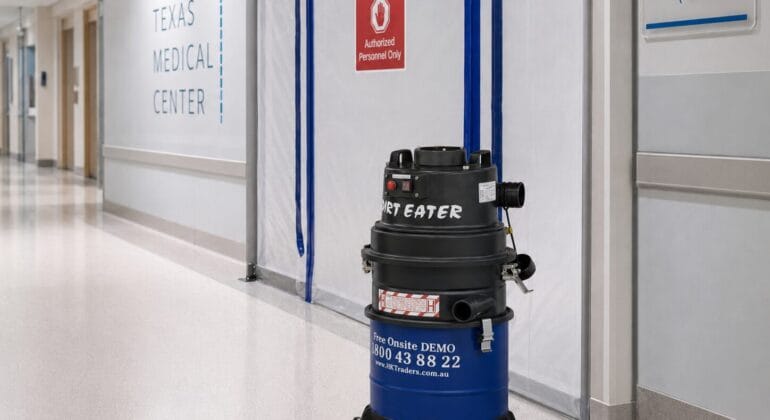
The Dirt Eater Junior is designed for healthcare environments where cleanliness, containment, and operational discretion are critical. Its compact footprint makes it ideal for crowded corridors, patient-adjacent work areas, equipment rooms, and contained renovation zones where space is limited.
Unlike bulky industrial units that can disrupt workflow, the Dirt Eater Junior is easy to position outside or near ICRA containment barriers and can be maneuvered on non-marking wheels through finished hospital spaces. Its sealed waste removal system helps minimize secondary exposure during disposal, reducing the risk of dust release when debris is collected, transported, or emptied.
The unit’s cyclonic operation supports efficient particle separation while maintaining strong suction performance. Just as important in active medical facilities, it is engineered for whisper-quiet operation—helping crews maintain productivity without creating unnecessary disturbance for patients, clinicians, or visitors.
For project managers, the Dirt Eater Junior supports tighter infection control execution and cleaner project turnover. For facilities engineering teams, it provides a practical, deployable solution for daily maintenance tasks, renovation support, and rapid response dust control. For infection prevention stakeholders, it reinforces the expectation that construction activities will remain contained, controlled, and aligned with hospital safety standards.
Protect Patients, Schedules, and Capital Budgets
In hospital construction, dust control failures are expensive because they affect more than the project site. They can interrupt care delivery, trigger emergency remediation, delay occupancy, and expose the facility to regulatory and operational risk. The right vacuum and filtration equipment can help prevent small particulate problems from becoming costly infection control events.