

# Controlling Hazardous Dust in Chemical Production: Sealed Industrial Vacuum Strategy for Compliance-Driven Operations
In chemical production plants, airborne particulate control is not a housekeeping issue—it is a process safety, industrial hygiene, environmental compliance, and product integrity requirement. Operations engineers responsible for powder transfer, milling, blending, packaging, reactor charging, filter press discharge, and maintenance cleanup must treat fugitive dust as a controlled hazardous stream. Even small releases of chemical powders can create inhalation exposure risks, contaminate adjacent production zones, compromise batch purity, and trigger regulatory scrutiny under OSHA and EPA frameworks.
## Why Airborne Cross-Contamination Is a Critical Worksite Risk
Chemical powders behave differently from ordinary debris. Fine particulate can become easily entrained in air currents generated by pneumatic conveying, local exhaust ventilation imbalance, compressed-air misuse, process equipment vibration, or personnel movement. Once airborne, particles can migrate beyond the immediate work area and settle on equipment, floors, control panels, packaging materials, or incompatible raw materials.
This creates three major operational risks:
1. **Worker inhalation exposure**
Airborne powders may present acute or chronic health hazards depending on toxicity, particle size, solubility, and exposure duration. Respirable fractions can penetrate deep into the lungs, while reactive, corrosive, sensitizing, or carcinogenic compounds may require strict exposure control. OSHA permissible exposure limits, substance-specific standards, hazard communication requirements, and respiratory protection programs all become central to plant compliance.
2. **Cross-contamination between products or process lines**
In multi-product chemical plants, residual powders can contaminate subsequent batches, especially where high-potency materials, catalysts, pigments, additives, intermediates, or specialty chemicals are handled. Contamination can lead to off-specification product, customer rejection, recalls, or dangerous chemical incompatibilities.
3. **Environmental release and regulatory exposure**
Fugitive particulate emissions can fall under EPA air emissions requirements, hazardous waste handling rules, stormwater contamination controls, and facility permit conditions. Poor dust control can also create problems during inspections, especially if visible dust accumulation suggests inadequate containment, housekeeping, or waste management practices.
For these reasons, operations engineers must design powder control systems that capture dust at the source, maintain containment during transport and disposal, and support repeatable cleaning validation.
## Hazardous Dust Handling: Multi-Stage Filtration and Leak-Control Mechanics
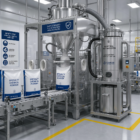
A properly engineered hazardous dust vacuum system is not simply a high-suction machine with a filter attached. It is a sealed particulate containment platform designed to prevent dust migration through every stage of collection, separation, filtration, and disposal.
The first principle is **source capture under controlled negative pressure**. When the vacuum inlet is connected to a cleanup tool, hose, floor wand, enclosure port, or process pickup point, the system must maintain sufficient airflow velocity to entrain powder without dispersing it. Negative pressure inside the collection path ensures that any minor pressure gradient drives air inward rather than allowing contaminated air to escape outward.
The second principle is **inertial separation before fine filtration**. Cyclonic or pre-separation stages remove larger and denser particles from the airstream by inducing rotational flow. Centrifugal forces drive heavier particulate toward the collection chamber wall, reducing dust loading on downstream filters. This improves airflow stability, extends filter life, and minimizes filter blinding during high-volume cleanup or process recovery activities.
The third principle is **progressive multi-stage filtration**. Instead of relying on a single filter, hazardous dust systems use staged filtration to capture progressively smaller particles. A typical configuration may include:
– A cyclonic pre-separator or drop-out chamber for bulk solids
– A primary cartridge or pocket filter for intermediate particulate loading
– A secondary high-efficiency filter for fine particulate retention
– A final safety or HEPA-grade filter where processes require high-efficiency capture of respirable fractions
This staged approach reduces the probability of particulate breakthrough because each stage protects the next. In hazardous chemical service, filter gaskets, housing interfaces, clamps, access doors, and discharge points are as important as filter media efficiency. A high-efficiency filter installed in a poorly sealed housing can leak around the filter rather than through it, defeating containment.
The fourth principle is **sealed dust discharge**. Many contamination events occur not during vacuuming, but during emptying. If operators must shake filters, dump open drums, or remove unsealed bags, captured powder can be re-aerosolized. Effective systems use containment-aware disposal methods: continuous liner systems, sealed bags, bag-in/bag-out components, gasketed collection vessels, or drum-style isolation mechanisms that allow operators to remove collected material without open exposure.
Finally, the system must be compatible with plant procedures for hazardous waste labeling, decontamination, lockout/tagout, combustible dust assessment, and personal protective equipment. For some chemicals, additional engineering considerations may include conductive or static-dissipative components, explosion-protected electrical designs, grounded hoses, corrosion-resistant wetted parts, and compatibility with solvents, oxidizers, or hygroscopic powders.
## Dirt Eater Series: Engineered for Sealed Chemical Powder Recovery
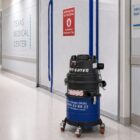
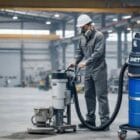
The Dirt Eater series is designed for operations teams that need industrial vacuum performance with containment-focused hazardous dust handling. Its fully sealed construction helps maintain negative-pressure integrity throughout the vacuum body, hose interface, filtration housing, and collection system. For chemical production environments where fugitive particulate control is mission-critical, sealed construction reduces the risk of bypass leakage and supports consistent containment during routine cleanup, spill response, and process-area maintenance.
The series uses **multi-stage cyclonic technology** to separate bulk particulate from the airstream before fine filtration. By forcing dust-laden air into a controlled cyclonic path, heavier particles are removed early in the collection process. This reduces filter loading, preserves suction performance, and decreases the frequency of filter service events—an important advantage when handling hazardous powders that should not be disturbed unnecessarily.
Downstream filtration stages are configured to progressively capture finer particulate while maintaining airflow. This architecture is especially valuable in plants where powders vary by density, morphology, moisture content, and particle size distribution. Whether operations involve granulated materials, fine crystalline powders, catalyst residues, additives, pigments, or process dust, staged separation helps maintain reliable capture performance across changing production conditions.
A key safety feature is the Dirt Eater series’ **zero-leak bag disposal mechanism**, engineered to minimize operator exposure during waste removal. Captured particulate remains isolated through the disposal process, helping compliance teams reduce re-aerosolization risk and improve housekeeping consistency. By limiting open handling of collected powder, the disposal system supports safer workflows for operators, maintenance technicians, and environmental health and safety personnel.
For compliance officers and operations engineers, the practical value is straightforward: sealed collection, cyclonic pre-separation, staged filtration, and controlled disposal combine to reduce fugitive dust movement from pickup to final containment. This supports OSHA-aligned exposure reduction efforts, EPA-conscious particulate control, and cleaner segregation between production zones.
## Schedule a Risk-Free On-Site Trial
Every chemical plant has unique dust hazards, process layouts, cleaning frequencies, and compliance requirements. The best way to evaluate containment performance is under real operating conditions.
Compliance officers should fill out the online form today to coordinate a risk-free, on-site Dirt Eater industrial vacuum trial. Test the system in your own production environment, review containment performance with your team, and determine the right sealed vacuum configuration for your hazardous powder handling program.